Ambulatory Care Sensitive Conditions in a Canadian Setting
Leslie L. Roos, Randy Walld, Julia Uhanova, Ruth Bond
Health Serv Res. 2005 Aug;40(4):1167-8
Pubmed
Editorial
The persistent challenge of avoidable hospitalizations.
Clancy CM
Health Serv Res. 2005 Aug;40(4):953-6
Pubmed
Friday, December 30, 2005
Health Serv Res - Physician Visits, Hospitalizations, and Socioeconomic Status
Thursday, December 29, 2005
AHRQ - Chronic Condition Indicator
The Chronic Condition Indicator is one in a family of databases and software tools developed as part of the Healthcare Cost and Utilization Project (HCUP), it provides an easy way for users to categorize ICD-9-CM diagnosis codes as either "chronic" or "not chronic."
The Chronic Condition Indicator is created to facilitate health services research on diagnoses using administrative data. This classification system allows researchers to readily determine if a diagnosis is a chronic condition. In addition, the tool groups all diagnoses into body systems so that users can create indicators listing which specific body systems are affected by a chronic condition.
Chronic Condition Indicator
Wednesday, December 28, 2005
Am J Med Qual - Relationship between performance measurement and accreditation
implications for quality of care and patient safety
Miller MR, Pronovost P, Donithan M, Zeger S, Zhan C, Morlock L, Meyer GS Am J Med Qual. 2005 Sep-Oct;20(5):239-52.
[Abstract] [PDF] [References]
Am J Med Qual -Training Health Care Professionals for Patient Safety
American Journal of Medical Quality 2005 20: 277-279.
Carolyn M. Clancy
[PDF] [References]
Tuesday, December 27, 2005
Ann Intern Med - Hospital at Home
Feasibility and Outcomes of a Program To Provide Hospital-Level Care at Home for Acutely Ill Older Patients
Bruce Leff, Lynda Burton, Scott L. Mader, Bruce Naughton, Jeffrey Burl, Sharon K. Inouye, William B. Greenough, III, Susan Guido, Christopher Langston, Kevin D. Frick, Donald Steinwachs, and John R. Burton
Ann Intern Med. 2005 Dec 6;143(11):798-808
Abstract Full Text PDF
Editorial
Hospital at Home: The Evidence Is Not Compelling
Sasha Shepperd
Ann Intern Med. 2005 Dec 6;143(11):840-1
Full Text PDF
Monday, December 26, 2005
NASHP - Maximizing the Use of State Adverse Event Data to Improve Patient Safety
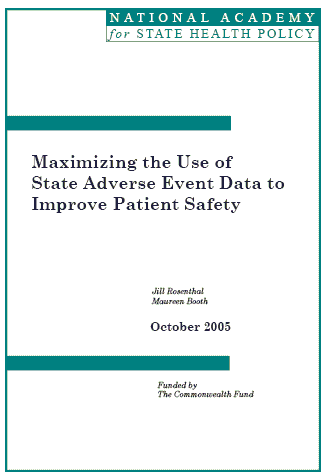 During the nearly six years since the Institute of Medicine released its first report on medical errors, there has been growing recognition of the size and scope of the problem.
Many US states have responded by creating or improving reporting systems for collecting hospital-based adverse events. As of September 2005, twenty-four states had passed legislation or regulation related to hospital reporting of adverse events.
In May 2005, National Academy for State Health Policy (NASHP) convened a meeting of data collectors, analysts, and users to identify mechanisms to improve reporting, tools used for event report analysis and dissemination, and opportunities for improvement.
This report reviews key findings from the meeting to assist states in improving their reporting systems and to encourage providers to improve the quality of the required reports so that data are credible and useful in shaping patient safety improvement interventions.
Full text
Friday, December 23, 2005
saferhealthcare - Out of the Shadows
Raising the Profile of healthcare associated infections (HCAI)
saferhealthcare.org.uk - 14 December 2005
Brian Duerden
Read
Int J Qual Health Care - Economic modeling of methods to stimulate quality improvement
Karen Eggleston
Int J Qual Health Care 2005 17: 521-531
[Abstract] [Full Text] [PDF]
Thursday, December 22, 2005
Qual Saf Health Care - Narrative methods in quality improvement research
T Greenhalgh, J Russell and D Swinglehurst
Qual Saf Health Care 2005; 14: 443-449
[Abstract] [Full text] [PDF]
Int J Qual Health Care - Policymaker use of quality of care information
Jacqueline J. Fickel and Carol R. Thrush
Int J Qual Health Care 2005 17: 497-504
[Abstract] [Full Text] [PDF]
Wednesday, December 21, 2005
Pediatrics - Unexpected increased mortality after implementation of a commercially sold computerized physician order entry system
Han YY, Carcillo JA, Venkataraman ST, et al.
Pediatrics. 2005;116:1506-1512.
Pubmed
Int J Qual Health Care - A performance assessment framework for hospitals
the WHO regional office for Europe PATH project
J. Veillard, F. Champagne, N. Klazinga, V. Kazandjian, O. A. Arah, and A.-L. Guisset
Int J Qual Health Care 2005 17: 487-496
[Abstract] [Full Text] [PDF]
Tuesday, December 20, 2005
BMJ - Scottish health service is ordered to release data on surgeons’ performance
Bryan Christie
BMJ 2005;331:1424
[Extract] [Abridged PDF] [Full text]
Anesthesiology - Validity of unplanned admission to an intensive care unit as a measure of patient safety in surgical patients
Haller G, Myles PS, Wolfe R, Weeks AM, Stoelwinder J, McNeil J.
Anesthesiology. 2005;103:1121-1129.
PubMed
Monday, December 19, 2005
Qual Saf Health Care - Control, compare and communicate
designing control charts to summarise efficiently data from multiple quality indicators
B Guthrie, T Love, T Fahey, A Morris, and F Sullivan
Qual Saf Health Care 2005; 14: 450-454
[Abstract] [Full text] [Web-only figures] [PDF]
Int J Qual Health Care - Patient perspectives of patient–provider communication after adverse events
Christine W. Duclos, Mary Eichler, Leslie Taylor, Javan Quintela, Deborah S. Main, Wilson Pace, and Elizabeth W. Staton
Int J Qual Health Care 2005 17: 479-486
[Abstract] [Full Text] [PDF]
Friday, December 16, 2005
Health Affairs - Blind faith and choice
Edwards RT
Health Affairs, Vol 24, Issue 6, 1624-1628
full text
J Gen Intern Med - What can hospitalized patients tell us about adverse events?
Learning from patient-reported incidents.
Weingart SN, Pagovich O, Sands DZ, et al.
J Gen Intern Med 2005 Sep; 20(9):830-836.
Pubmed
Thursday, December 15, 2005
ACSQ - Australian Council for Safety and Quality in Health Care Annual Report 2005

This sixth report is the last formal report to Health Ministers as the Australian Council for Safety and Quality in Health Care’s (Council) agreed extended term will finish in June 2006. It is set against a background of the Ministerial Review of future governance arrangements for safety and quality in health care.
This report builds on all five previous reports to Australian Health Ministers, provides a summary of achievements since Council’s inception in 2000 and identifies the foundation for future directions in safety and quality in Australia that has been built with the active support of many stakeholders.
final report
Australian Health Ministers Agree on New Safety and Quality Measures
Ministers agreed that the Australian Council for Safety and Quality in Health Care, which was established in January 2000, will be succeeded by a national body called the Australian Commission on Safety and Quality in Health Care which will report to Health Ministers and be closely linked to health departments and other government and non-government health bodies.
Ministers agreed with the Review finding (see previous news) that it was crucial that the state of safety and quality in the Australian health care system be regularly measured and reported publicly, and a new Australian Commission on Safety and Quality in Health Care would be charged with publishing a national report every two years.
read more
Subscribe to:
Posts (Atom)


 Posts

